
Ogemaw County Court Records exist as the primary legal history for all judicial actions within the county seat of West Branch, Michigan. These papers tell the story of every criminal case, civil lawsuit, and family matter handled by the local judges. The 34th Judicial Circuit Court and the 82nd District Court create these files whenever a lawyer or a citizen starts a legal action. Every motion, order, and judgment stays inside these archives to follow the rules set by the Michigan Public Records Act. People search for these files to check on past judgments, look at property disputes, or verify criminal histories for background checks. The Clerk of the Court keeps the papers safe in both paper and digital formats to make sure the legal process stays open to everyone. This transparency helps people know how the law works in their local area.

The 34th Judicial Circuit Court Docket
The 34th Judicial Circuit Court handles the most serious legal matters in the region. This court looks at felony cases where a person might go to prison for more than one year. It also looks at big civil cases where the money involved is more than twenty-five thousand dollars. When a person files a case here, the clerk assigns a case number that starts with the year and a two-letter code. These codes tell you if the case is criminal or civil. All Ogemaw County Court Records for this court stay in the main building on Houghton Avenue. The court also handles appeals that come from the lower district court. This means if someone thinks the district judge made a mistake, the circuit judge reviews the file to see what happened.
Family law is another huge part of the circuit court archives. These files include divorce papers, child custody orders, and support payments. The Friend of the Court office works with the circuit court to manage these specific records. They keep track of who owes money and who has the children on certain days. While many parts of these files stay open for everyone to see, some parts involving kids stay private to keep them safe. Lawyers and parents can look at their own files by showing an ID to the clerk. The records date back many years, showing how family law has changed in Michigan over the decades. Having these papers in one place makes it easier for families to get the orders they need for school or medical care.
Criminal Felony Case Files
Felony records in the circuit court contain every piece of evidence and every step of the trial. When the police arrest someone for a serious crime, the prosecutor files a document called an information. This paper lists the exact crimes the person is accused of doing. As the case moves forward, the record grows with motions from the defense lawyer and responses from the state. You can see the names of witnesses, the dates of hearings, and the final sentence given by the judge. These files are useful for people who need to see if a person has a serious criminal past. The clerk makes sure these papers stay in order so the public can see that the trial was fair and followed the law.
The sentencing phase produces a document that explains the punishment. This might include time in a state prison or a period of probation. The record also shows if the person has to pay money to the victim, which is called restitution. Because these crimes are serious, the state keeps these records for a very long time. Even if a case ended twenty years ago, you can often locate the summary in the digital archive. For older cases, you might need to ask the clerk to get the paper file from the storage room. These documents prove that the court did its job and that the person finished their sentence as required by the state of Michigan.
The 82nd District Court Case Search
The 82nd District Court handles the smaller legal issues that happen every day. This court looks at misdemeanors, which are crimes that lead to less than one year in jail. Most people interact with this court for traffic tickets, such as speeding or driving without a license. The court also looks at civil cases where the money is less than twenty-five thousand dollars. These Ogemaw County Court Records are busy because so many people have small legal needs. The clerk’s office for the district court stays in the same building as the circuit court but has its own staff. They manage the daily calendar and make sure the judges have the right files for every hearing.
Small claims cases also live in the district court records. These are cases where people sue each other for small amounts of money without using expensive lawyers. The records show the names of both sides, what the fight was about, and who the judge decided was right. Landlord and tenant disputes, such as evictions, are also kept here. These files show if a person was forced to leave their home because they did not pay rent or broke a rule. Because these cases move fast, the records update quickly. You can often see the result of a morning hearing by checking the system later that same afternoon. This speed helps businesses and renters get the answers they need to move on with their lives.
Traffic and Misdemeanor Dockets
Traffic records make up the largest number of files in the district court. Every time a police officer writes a ticket, it goes into the court system. The record shows the date of the ticket, the law that was broken, and the fine that was paid. If a person goes to court to fight the ticket, the record shows what the judge decided. These files are important for insurance companies and the Secretary of State. They use this data to decide if a person should keep their driver’s license or pay more for insurance. Most traffic records stay in the system for several years before they are moved to deep storage.
Misdemeanor files cover things like simple assault, petty theft, or driving while drunk. These records show the person’s mugshot in some cases, the police report summary, and the plea deal if there was one. Many people resolve these cases by paying a fine or doing community service. The record tracks all these steps to make sure the person follows the judge’s orders. If someone fails to do what they were told, the record shows that a warrant was issued for their arrest. This keeps the community safe by making sure people are held accountable for their actions. The public can search these records by name to see if someone has a history of these smaller crimes.
Ogemaw County Probate Court Records
The Probate Court manages files related to people who can no longer take care of themselves or who have passed away. When a person dies, their will goes to the probate court to make sure their property goes to the right people. This creates a record that lists all the things the person owned, from their house to their bank accounts. The record also lists the names of their family members and who is in charge of the estate. These Ogemaw County Court Records are helpful for researchers looking into family history or for creditors who need to get paid. The probate clerk handles these sensitive papers with great care to protect the legacy of the deceased.
Guardianship and conservatorship cases also stay in the probate office. These files are created when a judge decides that an adult or a child needs someone else to make decisions for them. This might happen because the person is very old, has a disability, or lost their parents. The record shows the name of the person appointed to help and the rules they must follow. Every year, the helper must file a report showing how they spent the person’s money and how the person is doing. These reports are part of the public record but have some private details hidden. This system ensures that vulnerable people stay safe and that no one steals their money or property.
Wills, Estates, and Trusts
When a case starts in probate court, the first paper is often a petition to open an estate. The court record then follows the path of the money and property. You can see the inventory list which shows the value of everything the person left behind. If there is a fight over the will, the record shows the arguments from both sides and the judge’s final word. These files are often very thick because they contain many receipts and legal notices. People can look at these records to see if a house has a clear title or to learn about their ancestors. The probate court in West Branch keeps these files organized by the name of the deceased person.
Trusts are another type of file managed here. A trust is a way to hold money for someone else, often a child or a charity. The records show who created the trust and how the money should be used. Sometimes these trusts stay active for many decades. The court record acts as a permanent witness to the wishes of the person who started the trust. If the person in charge of the money does a bad job, the court record shows the legal steps taken to fix the problem. This oversight protects the money for the people who are supposed to get it in the future.
Searching the Ogemaw County Court Records Database
The best way to see Ogemaw County Court Records today is through the digital search tools provided by the state. Michigan uses a system called MiCOURT that lets anyone search for cases from their home computer. To use this tool, you need the name of a person or a specific case number. You can filter the results by court type, such as circuit or district. The system shows a list of every event that happened in the case, from the first filing to the final judgment. While you might not see the full scanned image of every paper, you can see the summary of what those papers say. This makes it much faster to get details without driving to the courthouse.
If the digital system does not have what you need, you can visit the courthouse in person. There are public computer terminals in the lobby where you can search the records for free. The staff at the counter can help you if you get stuck or if you need a paper that is not online. For very old records from the early 20th century, you may need to look through physical books or microfilm. These old Ogemaw County Court Records are kept in a climate-controlled room to stop the paper from falling apart. Whether you use a computer or a book, the goal is the same: to find the truth about a legal matter. Most people find that a mix of online searching and a quick phone call to the clerk works best.
Requesting Certified Copies of Court Files
Sometimes a simple look at a record is not enough. You might need a certified copy for a social security application, a job, or a different court case. A certified copy is a paper that the clerk stamps and signs to prove it is a true copy of the original. To get these, you must tell the clerk which case and which specific pages you need. There is usually a fee for this service, which covers the cost of the paper and the clerk’s time. You can ask for these copies in person, by mail, or sometimes through the online portal. The clerk will verify the record and then send you the official document with the court’s seal.
The cost for Ogemaw County Court Records depends on how many pages you need. Usually, there is a flat fee for the first page and a smaller fee for every page after that. If you need the clerk to search for a record because you do not have the case number, there might be an extra search fee. It is a good idea to call ahead and ask for the total price so you can bring the right amount of money. The court accepts cash, checks, and often credit cards. Once you pay, the clerk processes the request. Most people get their copies right away if they are in the office, but mail requests can take a week or two to arrive at your home.
Court Records Retention and Michigan Law
Michigan has strict rules about how long the clerk must keep Ogemaw County Court Records. Not every paper stays forever. For example, some small traffic records might be destroyed after seven or ten years to save space. However, serious crimes and property records stay for many decades or even forever. The Michigan Supreme Court sets these schedules to balance the need for history with the limited space in the courthouse. The clerk follows these rules closely to make sure no important data is lost. If a record is slated for destruction, the clerk must follow a specific legal process to ensure it is done correctly.
The Freedom of Information Act and the Michigan Court Rules work together to keep these records open. While most people think of FOIA for government emails, court records have their own set of rules under MCR 8.119. This rule says that all court records are public unless a law or a judge specifically says they are not. This means you do not usually need to file a formal FOIA request to see a case file. You just need to ask the clerk to see it. This high level of openness is a key part of the American legal system. It makes sure that judges and lawyers are doing their jobs right because anyone can come in and check their work at any time.
Civil Judgment Records and Liens
Civil judgments are a major part of the Ogemaw County Court Records archive. When a judge decides that one person owes another person money, they sign a judgment. This paper is a powerful tool. It can be used to take money from a person’s paycheck or to put a lien on their house. A lien means that if the person sells their house, the money from the sale goes to pay off the debt first. Credit card companies and banks often search these records to see if a person is good at paying their debts. If you have a judgment against you, it will show up on your credit report and in the public records for many years.
You can also find records of satisfied judgments. This happens when the person pays off the debt and the winner of the case files a paper saying the debt is gone. It is very important to make sure this paper gets filed, or the debt will look like it is still owed. The records also show if a judgment was renewed. In Michigan, a judgment lasts for ten years, but it can be renewed for another ten years if the money is still not paid. Searching these Ogemaw County Court Records helps buyers know if a piece of land is safe to buy or if there are hidden legal problems tied to the property.
The Role of the Ogemaw County Clerk
The County Clerk has a dual role in West Branch. They act as the clerk for the 34th Judicial Circuit Court and also manage the county’s vital records. This means the same office that holds your divorce papers might also hold your birth certificate or your marriage license. For Ogemaw County Court Records, the clerk’s job is to receive every new filing, stamp it with the date, and put it in the right folder. They make sure the judge sees the papers before a hearing and that the final orders get sent to the right people. Without the clerk, the court would not be able to function because no one would know what happened in previous hearings.
The clerk also manages the jury system. They use the records to find people in the county who can serve as jurors for trials. They keep track of who showed up and who was excused. This part of the record is mostly private, but the overall numbers are public. The clerk’s office is often the busiest place in the courthouse. They handle phone calls from worried people, help lawyers file complex motions, and keep the computer systems running. Their dedication to keeping clean and accurate records is what allows the justice system in Ogemaw County to remain stable and trusted by the local citizens.
Topical Authority Improvement Plan
To fully master the landscape of local legal data, several areas require deep attention. The following list shows the parts of the legal system that connect directly to court files but are often missed by casual researchers.
| Entity Name | Record Type | Search Impact |
|---|---|---|
| Friend of the Court | Custody and Support | High for family history |
| Ogemaw Register of Deeds | Land Liens and Titles | Critical for property law |
| Michigan SCAO | Court Forms and Rules | Essential for filing logic |
| West Branch Police Dept | Arrest Reports | Primary source for criminal files |
| Michigan MiCOURT | Electronic Docket | Main search portal tool |
- Jury Selection Records: These documents show how the county picks people to help with trials.
- Bond and Bail Records: These files track the money paid to get someone out of jail while they wait for court.
- Appellate Records: Documents created when a local case moves up to the Michigan Court of Appeals in Lansing.
- Warrants: Active and cleared orders from judges to arrest people or search properties.
- Mediation Files: Records showing how people settled their fights outside of a full trial.
Search Intent Map
People looking for Ogemaw County Court Records usually have one of four goals. This map shows why people search and what they expect to find in the archives.
- Background Checking: People want to see if a person has a criminal record before hiring them or renting to them. They look for felony and misdemeanor convictions.
- Legal Research: Lawyers look at old cases to see how a judge ruled in the past. This helps them win new cases by using old examples.
- Debt Verification: Collection agencies and banks check for judgments and liens to see if someone owes money to the court or other people.
- Family Genealogy: People look at old probate and marriage records to build their family tree and learn about their ancestors in West Branch.
Each of these goals requires a different way of searching. A person doing a background check might only need a name search. A lawyer might need to read every single motion in a file to find a specific legal argument. A genealogist might spend hours looking at old handwritten books from the 1800s. The Ogemaw County systems are built to serve all these different needs at the same time.
Location and Contact Details
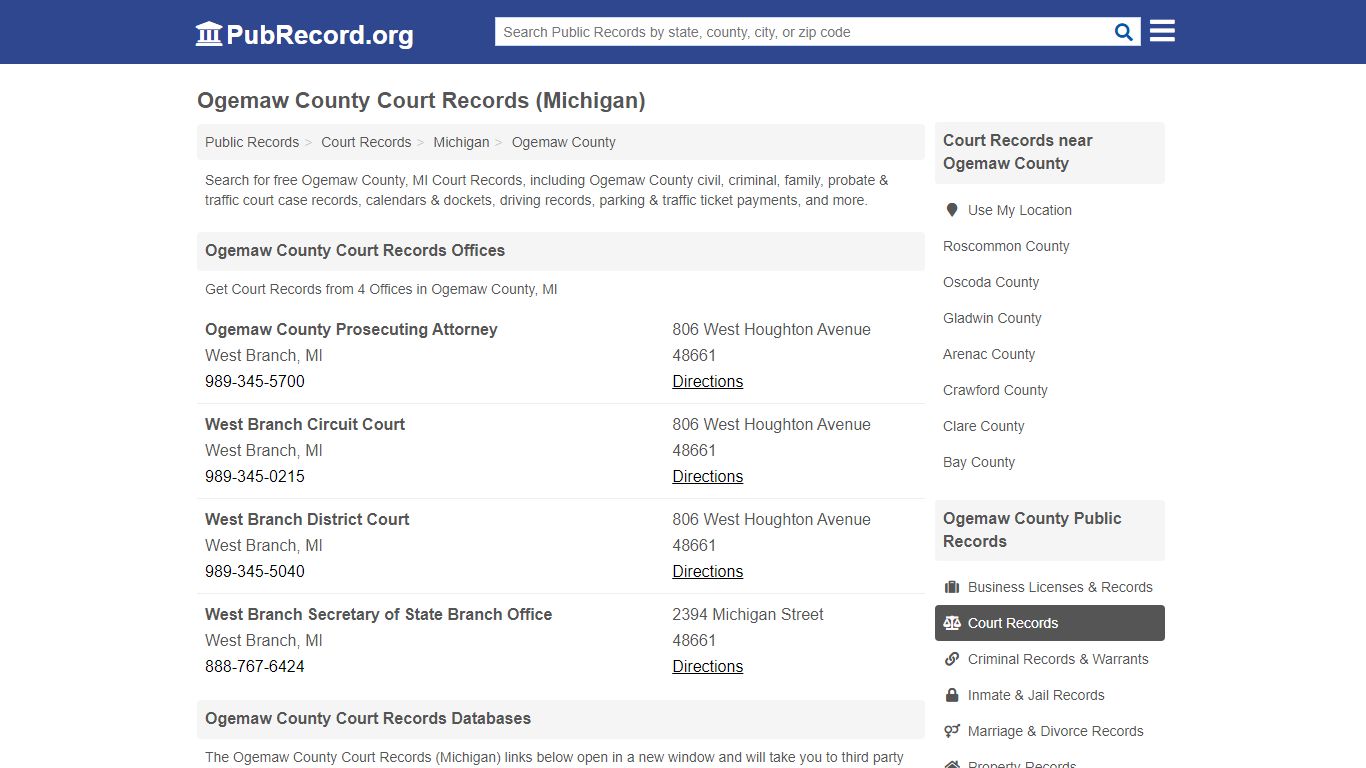
The offices for Ogemaw County Court Records are centrally located to help all residents. You can visit during normal business hours to look at files or talk to a clerk. It is usually best to arrive in the morning when the office is less crowded.
Address: 806 West Houghton Avenue, West Branch, MI 48661
Phone (Circuit Court): 989-345-0215
Phone (District Court): 989-345-5040
Phone (Probate Court): 989-345-0145
Hours: Monday through Friday, 8:30 AM to 4:30 PM (Closed on holidays)
Frequently Asked Questions
These questions address common concerns people have when they search for Ogemaw County Court Records. These answers help you save time and get the exact files you need for your legal or personal goals.
How do I search for Ogemaw County Court Records online?
You can search for these records by using the MiCOURT website, which is the official portal for the state of Michigan. When you arrive at the site, you must choose Ogemaw County from the list of locations. You can then select either the 34th Circuit Court or the 82nd District Court. Enter the first and last name of the person you are looking for. If you have a specific case number, entering that will give you the fastest result. The system will show you a list of cases that match your search. Click on a case number to see the docket, which is a list of every event in that case. You will see dates for hearings, the names of the lawyers, and the judge’s final orders. While you can see the summary for free, you usually cannot download the actual signed documents without paying a fee or visiting the court in person. The site is open 24 hours a day, which makes it very easy to use from home. If the name you are searching is common, try adding a middle name or birth year to narrow down the list.
Are juvenile court records available to the public?
No, most juvenile court records in Ogemaw County are not open to the general public. Michigan law protects the privacy of children to make sure a mistake made when they were young does not hurt them for the rest of their lives. These files include things like delinquency cases, where a child is accused of a crime, and neglect cases, where the court is checking on a child’s safety. Only the parents, the lawyers involved, and the child (once they are old enough) can see these files. If you are a member of the public and you try to search for a juvenile case in the Ogemaw County Court Records database, you will likely see a message saying the record is restricted or confidential. There are very rare times when a judge might open a juvenile record, such as if the crime was extremely serious and the child was tried as an adult. For almost everyone else, these files stay locked away. If you need your own juvenile record, you must go to the courthouse with a valid photo ID and ask the clerk for help.
Can I see Ogemaw County Court Records for free?
Yes, you can see most Ogemaw County Court Records for free if you visit the courthouse in West Branch. The clerk’s office has public computer terminals that allow you to browse the case database without paying a cent. You can read the summaries of the cases and see what happened at different hearings. If you want to look at the actual paper file, you can ask the clerk to bring it to you. In most cases, they will let you sit in a designated area to read through the papers. However, “free” only applies to viewing the records. If you decide you want to take a copy home with you, or if you want a digital file sent to your email, the court will charge a fee. These fees are set by the state and go toward the cost of running the record system. Also, some very old records stored off-site might require a small retrieval fee. For the average person just wanting to check a case status or read a judgment, visiting the courthouse terminals is the best way to do it without spending money.
How far back do the Ogemaw County Court Records go?
Ogemaw County Court Records date back to the late 1800s and early 1900s. The county was formed in the 1870s, and legal record-keeping began shortly after that. The oldest records are usually found in large, handwritten ledger books. These books contain the early history of land disputes, the first criminal trials in the area, and probate files for the county’s original settlers. As the years went on, the court moved to typed papers and eventually to the digital files we use today. While the computer database usually only goes back to the 1980s or 1990s, the physical archives hold much older data. If you are looking for a record from the mid-1900s, it might be on microfilm or stored in a box in the courthouse basement. The clerk can help you find these older files, but it might take a few days for them to locate the right box and bring it to the counter. These historical records are a goldmine for people studying the growth of West Branch and the surrounding townships over the last century.
What should I do if I find an error in my court record?
If you see a mistake in your Ogemaw County Court Records, you must act quickly to fix it. Errors can happen if a clerk types a name wrong or if a judge’s order was not entered correctly. First, you should get a copy of the record that shows the mistake. Then, you should contact the clerk’s office to see if it is a simple clerical error they can fix right away. If the mistake is more serious, like an incorrect judgment or a wrong sentencing date, you might need to file a formal motion with the court. This motion asks the judge to correct the record to reflect the truth. You may want to talk to a lawyer to help you write this motion, as it must follow specific court rules. Once the judge signs an order to fix the error, the clerk will update the database. It is important to fix these mistakes because they can affect your credit score, your ability to get a job, or your right to own a firearm. Always keep a copy of the corrected order for your own files in case the old, incorrect data shows up somewhere else later.
Can I see divorce records in Ogemaw County?
Yes, divorce records are part of the public Ogemaw County Court Records. These cases are filed in the 34th Judicial Circuit Court. You can search for them using the names of the people who were married. The public record will show when the divorce started, the reason given (though Michigan is a “no-fault” state), and when the final judgment was signed. You can also see orders regarding how property was split and who gets the house or the cars. However, parts of the file that contain sensitive data like social security numbers or specific bank account details are often redacted or hidden from the public. If the divorce involved children, the records concerning the kids’ health or specific school details might be private. Most people can see the general judgment of divorce, which is the paper that proves the marriage has ended. This is often needed if one of the people wants to get married again or needs to change their name on a driver’s license or passport. The clerk can provide a certified copy of the judgment for a standard fee.
How do I find out about upcoming court dates?
Finding upcoming court dates in Ogemaw County is simple if you use the online docket calendar. The court publishes a list of all hearings scheduled for the week and the month. You can search this calendar by the judge’s name or by the case name. This is very helpful if you need to attend a hearing or if you just want to see when a specific trial is going to happen. The calendar shows the time of the hearing, the room number, and what type of event it is, such as a motion, a pre-trial, or a sentencing. Keep in mind that court schedules change often. Lawyers sometimes ask for more time, or a judge might have an emergency. It is always a good idea to check the calendar the night before the hearing to see if the time has changed. You can also call the clerk’s office at the numbers listed above to verify a date. If you are a party in a case, the court will also send you a notice in the mail, but checking the online system is the fastest way to stay updated on any changes.